The Basics of Integrated Vegetation Management

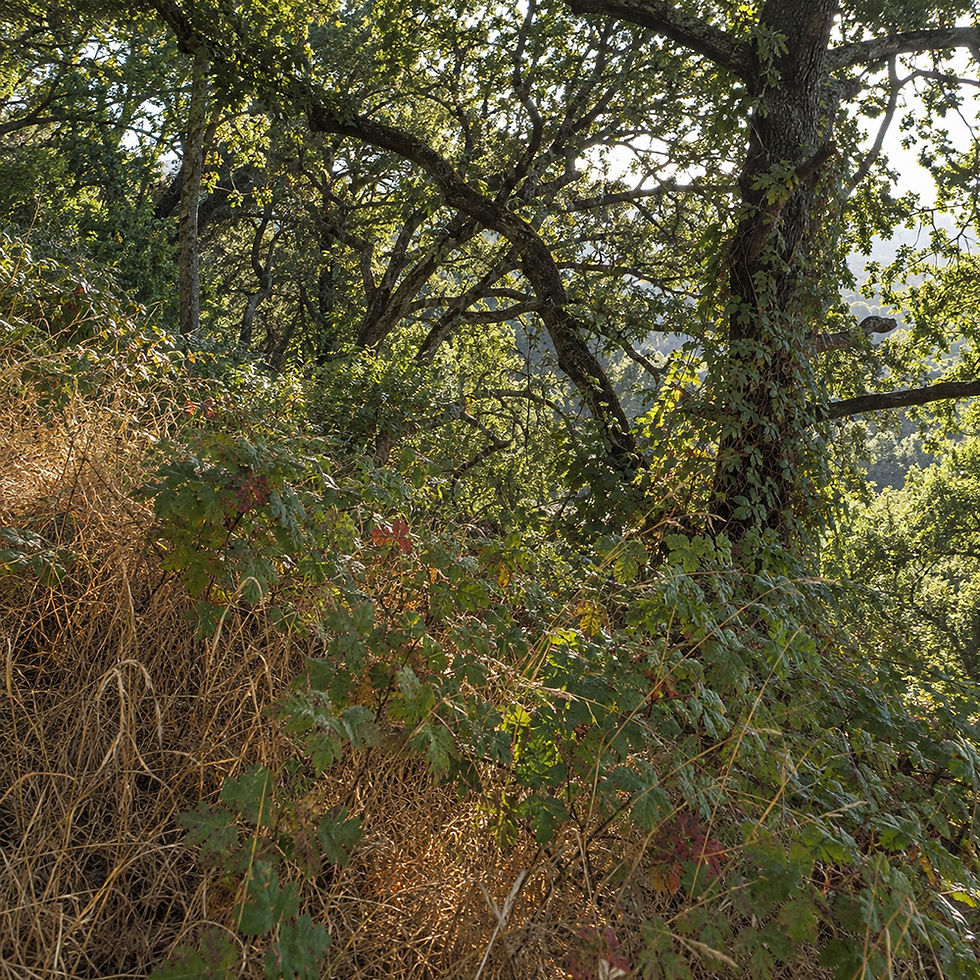
Wildfire resilience begins with understanding how fire moves through a landscape. One of the most important goals of integrated vegetation management is to interrupt the pathway that allows fire to climb from the ground into the tree canopy.
Start with the flashy fuels
Flashy fuels are fine, dry vegetation—annual grasses, weeds, leaves, small twigs, and other lightweight plant material—that can ignite quickly and carry fire rapidly across the ground.
Mechanical vegetation management can reduce these fuels through mowing, cutting, raking, chipping, and selective removal. The goal isn't to clear the landscape. It is to reduce the amount and continuity of fuel while retaining healthy, ecologically valuable vegetation.
This distinction matters. CAL FIRE describes hazardous fuels as accumulated live and dead vegetation that can increase fire intensity and allow fire to move from surface fuels into ladder and crown fuels.

Then break the ladder
Ladder fuels are the vegetation that creates a vertical connection between the ground and the canopy: grasses and shrubs, small trees, dead branches, and dense understory vegetation.
Think of it as a ladder: Ground fuels connect to low vegetation. Low vegetation connects to shrubs. Shrubs connect to small trees. Lower tree branches connect to the canopy.
When that ladder is intact, a surface fire can climb upward. Once fire reaches the canopy, it becomes much more difficult to control.
Mechanical thinning is therefore about breaking the chain. Depending on the landscape, this can mean selectively removing dead vegetation, thinning dense understory, pruning lower branches, removing small or poorly positioned trees, and creating strategic gaps between fuel layers.
There is some fascinating science behind this idea. A 2024 study examining 42 California wildfires using NASA satellite LiDAR data found that vertical fuel continuity—particularly ladder fuels—was more consistently associated with wildfire severity than total canopy volume, including under extreme topography and weather conditions.

Mechanical thinning is not the whole toolbox
Mechanical treatment is one component of integrated vegetation management, not a substitute for every other treatment.
Cutting and chipping can rapidly modify vegetation structure. Prescribed fire can address accumulated surface fuels. Targeted grazing can reduce smaller live fuels. Restoration can replace problematic vegetation with healthier plant communities. Ongoing maintenance is essential because vegetation grows back.
A particularly interesting 2025 California study used 29 million NASA GEDI LiDAR observations to compare different fuel treatments. It found that mechanical treatments produced measurable reductions in fuel structure that persisted for roughly 9–15 years, while different treatments affected canopy and ladder fuels in different ways.
That points toward a more useful way of thinking about vegetation management: not “clear or don't clear,” but “what fuel are we trying to change, where, and for how long?”
The goal isn't bare ground
Good vegetation management is not simply clearing, it is strategic interruption.
Healthy trees, native shrubs, wildlife habitat, and soil-building vegetation can remain while excessive, dead, densely packed or continuous fuels are reduced. Where appropriate, chipped vegetation can become mulch or compost feedstock rather than waste.
The goal is to change the way fire moves through the landscape.
Reduce the flashy fuels. Break the ladder. Protect the canopy. Keep fire on the ground, and out of the trees.
Want to go deeper into the topic? A few unusual and especially interesting reads:
The ladder may matter more than the canopy.
This recent Nature study is one of the best scientific explanations of why vertical fuel continuity matters: “Ladder fuels rather than canopy volumes consistently predict wildfire severity”
Scientists actually tested ladder-fuel ignition.
A 2026 Fire Ecology study used 92 controlled experiments to examine exactly when ladder fuels ignite—including live manzanita and incense cedar. “Analysis of ladder fuel ignition through experiments and fire dynamics simulator simulation”
NASA is helping measure vegetation treatment from space.
Researchers used GEDI spaceborne lidar to compare mechanical thinning, prescribed fire, fuel breaks and other treatments across California. “Comparing the spatial effects and longevity of key fuel treatments in California using spaceborne lidar data”
What happens when a wildfire actually reaches a treatment?
A California study of 12 wildfires found that treatments removing surface and ladder fuels were associated with substantially lower fire severity and tree mortality; canopy fires were often reduced to surface fires within treated areas. “Fuel treatment effectiveness in California yellow pine and mixed conifer forests”
CAL FIRE's practical perspective.
Their vegetation management program explicitly describes surface and ladder-fuel reduction as a way to prevent ground fires from quickly transitioning into crown fires. CAL FIRE Vegetation Management Program
The larger lesson is that vegetation management is really fire-behavior management. We aren't trying to eliminate nature. We are changing the structure and continuity of fuels so that when fire arrives, there are fewer opportunities for it to climb, accelerate, and become catastrophic.